Introduction
The AI era isn’t replacing software engineers. It’s raising the bar for what a great one looks like.
Over the past few years, AI tools like GitHub Copilot, ChatGPT, and Claude have fundamentally changed how software teams work. Code gets written faster. Repetitive tasks get automated. But here’s the thing — the engineers who are truly thriving aren’t the ones worried about AI. They’re the ones who’ve figured out how to use it as leverage.
So what separates engineers who grow in this new era from those who struggle? It comes down to two categories: technical skills that matter more than ever, and human skills that AI simply cannot replace.
Technical Skills That Matter More Than Ever
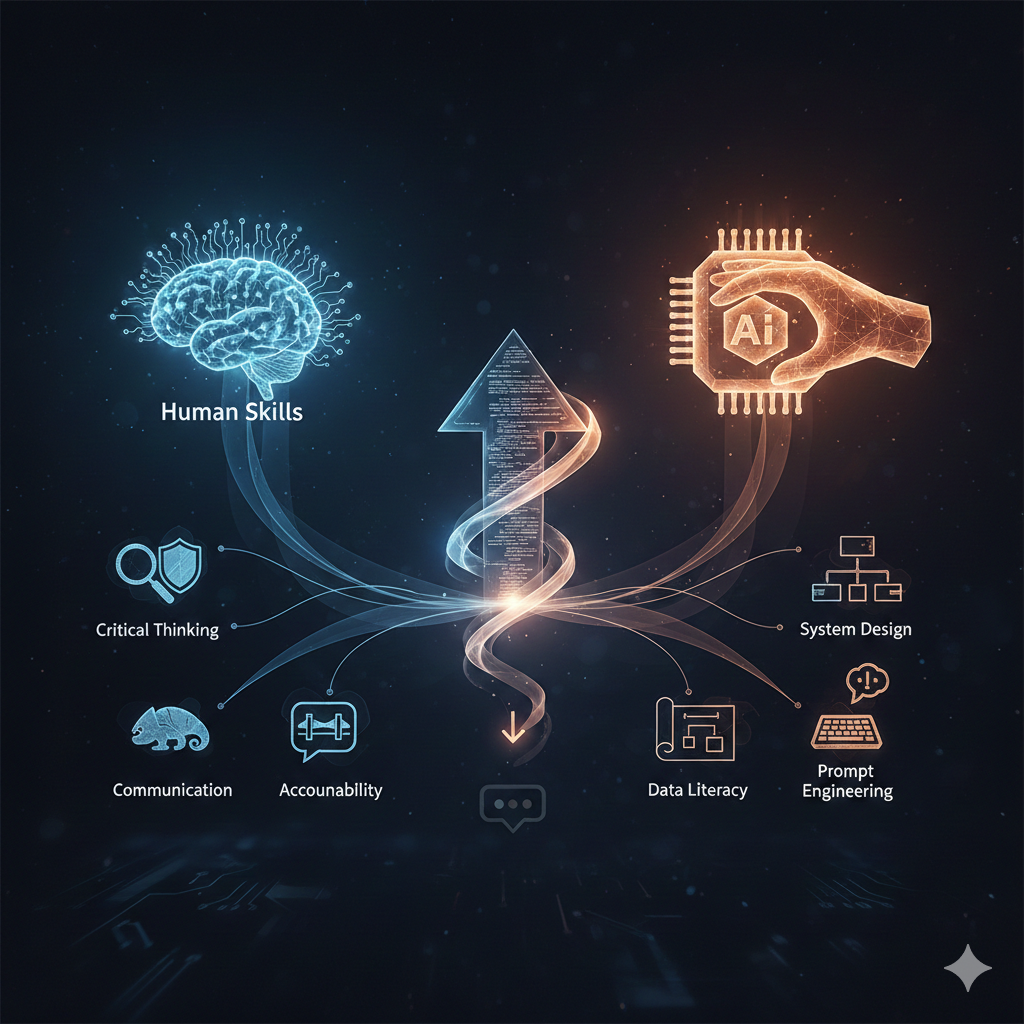
- System Design: AI can write code, but it cannot architect scalable, fault-tolerant systems for you. Understanding how to design databases, APIs, microservices, and infrastructure at scale remains one of the most valuable — and distinctly human — skills in software engineering.
If you can look at a product requirement and ask “how do we build this so it handles 10 million users without breaking?” — you’re indispensable. - Data Literacy: AI runs on data. Engineers who understand data pipelines, model inputs and outputs, and how to interpret results have a massive advantage. You don’t need to be a data scientist, but understanding the basics of how data flows through a system is now a baseline expectation.
- Prompt Engineering: Knowing how to direct AI tools effectively is a genuine superpower. Writing a vague prompt gives you a mediocre result. Writing a precise, well-structured prompt gives you something you can actually ship. This skill is still widely underestimated – and that’s your opportunity.
Human Skills AI Cannot Replace
- Critical Thinking: AI generates answers. Humans ask the right questions. The ability to challenge assumptions, spot flaws in logic, and think through edge cases is something no model can fully replicate. Engineering is fundamentally about solving the right problem – not just the stated one.
- Accountability and Decision-Making: AI can suggest. It cannot own a decision. Engineers who can weigh trade-offs, make a call, and stand behind it are the ones who get trusted with bigger responsibilities.
- Communication: Being able to explain a complex technical concept to a product manager, a founder, or a customer is a rare and powerful skill. The engineers who can bridge the technical and non-technical worlds will always have a seat at the table.
- Adaptability: Perhaps the most important skill of all. The tools will keep changing. The frameworks will keep evolving. The engineers who succeed long-term are the ones who stay curious, embrace change, and are willing to unlearn old habits to pick up new ones.
The Bottom Line
AI is not your competition. Complacency is.
The engineers growing fastest right now are using AI to do more — while doubling down on the skills that make them irreplaceable. Stronger system thinkers. Better communicators. Faster learners.
The question isn’t whether AI will change your job. It already has. The question is: are you evolving with it?
What skill are you investing in right now? Share it in the comments below.